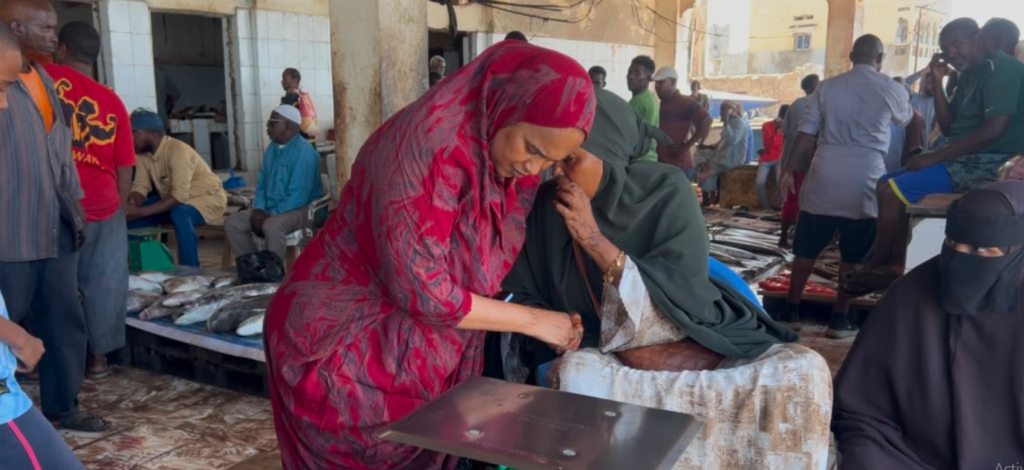
Every morning, as the sun rises over Mogadishu’s coastline, the Hamar Weyne Fish Market comes alive. The voices of fishermen, customers, and traders fill the air as fresh fish brought from the sea is unloaded and prepared for sale. For many years, the market has been largely dominated by men, but today, more women are becoming a visible part of the business, selling fish and building livelihoods to support themselves and their families.
Among them are members of the Kaahiye Women’s Fisheries Cooperative, a group of more than 150 women who have joined together to enter a sector that has traditionally been viewed as a man’s domain.
Through cooperation, training, and shared efforts, the women have gained skills, employment opportunities, and a more secure source of income, allowing them to play a greater role in supporting their families.
Fatumo Abdi Nur, the chairperson of the Kaahiye Women’s Fisheries Cooperative, said the idea behind forming the group came from the challenges women faced in accessing opportunities in the fish trade.
“What motivated us was that women were not receiving the same recognition, support, and opportunities as men. We decided to come together and support one another. We face many challenges, but they do not stop us. We are mothers with children to care for, and we have to work,” she said.
Inside the market, the women can be seen sorting fish, serving customers, and managing daily sales. For many of them, the business represents more than just a source of income; it is a path toward financial independence.
Fatumo said the cooperative has also supported women facing difficult circumstances, including divorced women and those raising children on their own.
“We have trained many women, including divorced women and those who are the sole providers for their children, and helped them find work. Today, they earn an income from the fish market and can support their families, including their children’s education,” she said.
Hawwa Abdi Abdiasis, a member of the cooperative, said joining the group changed her life by helping her learn a new skill and become financially independent.
“Before, I did not know much about the fish business. They taught me how to do this work and helped me develop the skills I needed. Today, I have learned the trade and earn my own income, Alhamdulillah,” she said.
However, Hawwa said women working in the fish market still face challenges, particularly from social attitudes.
“The biggest challenge is that some men do not want women to work in the market or compete with them. But women need opportunities to work and support their families,” she added.
Despite these challenges, some male fish traders have welcomed the growing involvement of women in the market.
Ahmed Mumin, a fish trader, said the market has changed significantly over recent years.
“In the past, the market was mostly dominated by men, but today many women have become part of it. They have shown commitment and ability. I believe women should be given the opportunity and freedom to work,” he said.
Although cultural and social barriers remain, the women of the Kaahiye Women’s Fisheries Cooperative are showing that determination and cooperation can change perceptions.
Standing in the Hamar Weyne Fish Market, with the fish they sell and the businesses they have built, these women are not only earning a living; they are creating new opportunities for themselves, supporting their families, and proving that Somalia’s markets can also be places where women succeed.
By Hawo Nor, Bilan Media